
Aspasia Velonaki - AIPS Europe EC Member
1. Among the goals that you and FIAS had set for 2024, which ones have been met and which ones need to be fulfilled during 2025?
- One of the main goals that we pursue is the inclusion of SAMBO in the Olympic Games program. We have already made some great and significant strides in reaching it of late. Let me remind you that FIAS was granted provisional recognition in 2018 and permanent recognition in 2021 from the International Olympic Committee, thus becoming a full member of the Olympic family.
The number of countries where SAMBO is being developed is growing year by year. Today, FIAS has 101 national federations, apart from 17 candidate member countries. Yet the rising popularity of our sport worldwide and the global evolution of masterly skills are best evidenced by the wins of athletes from such countries as Cameroon, Korea, Venezuela, Romania, France, Israel at the World Championships. Not to mention the silver and bronze that are repeatedly scored by Morocco, Indonesia, the Philippines, Colombia, Tunisia, Greece, the Netherlands, Mexico, Guinea, and others. At the latest World Championships in Kazakhstan, medals went to 25 countries, a figure that speaks for itself. Such strikingly good performance was hard to imagine some 10-15 years back, and today it's a real thing. There is also an ever-increasing number of national and international tournaments staged all across the globe.
But to return to the year 2024, I would rank the inclusion of SAMBO in the program of the African Games in Ghana as our chief accomplishment. And we take tremendous pride in being able to reach this height.
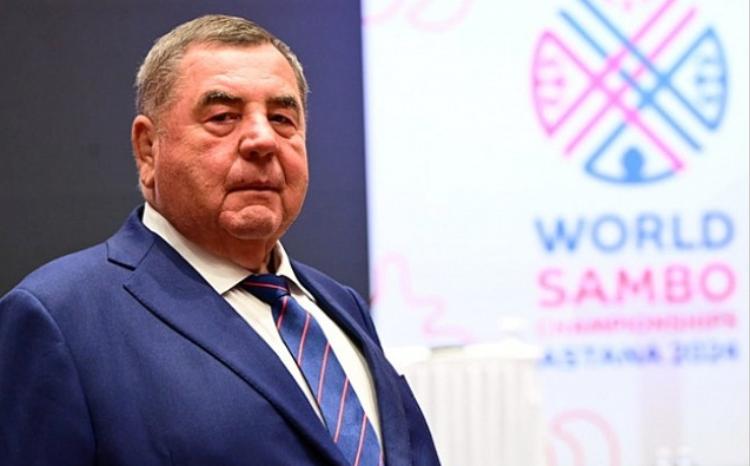
Besides, I wish to draw your attention to the fact that competitions in women's combat SAMBO and SAMBO for the Blind are now incorporated in the program of the World Championships. For the first time in the history of FIAS, this took place in Astana, heralding another major step forward.
2. Following the success of the 2024 World SAMBO Championships in Kazakhstan, how high do you set the bar in the run-up to the 2025 World SAMBO Championships?
- As they say, there is no limit to perfection. No matter how well the central tournament of the FIAS calendar plays out, you should always try and make the next tournament even better and raise the plane tirelessly. Every time we strive to enhance the representation of athletes and countries, closely monitor the conditions of their accommodation, food, and training. As a sambist in the past, I can state that nothing should distract an athlete from competition. When stepping on the mat, a sambist should get a fair chance to demonstrate all their best qualities, both technique and stamina. Also of no lesser value is the atmosphere of the competitions, in our case it is invariably an air of festivity, because SAMBO is but one large family. As I always say: we are contenders on the mat, and friends beyond it! And these are not just abstract words.
3. At the 2024 World SAMBO Championships in Kazakhstan, medals in Blind SAMBO competitions were awarded for the first time! What has been the response (feedback) from blind athletes themselves, coaches and national federations to that addition to the World Championship schedule? Are you planning to include more categories regarding athletes with disabilities (i.e. deaf athletes etc).
- We are highly committed to the expansion of SAMBO among people with disabilities. And indeed, the competitions for visually impaired sambists in Astana were featured in the main program along with major varieties such as sport and combat SAMBO. As far as I know, it might be the very first experience of this kind, for typically blind and visually impaired athletes in other martial arts perform separately from the rest, on a different day. And today we can surely state that this experience has truly revolutionized this sport. The World SAMBO Championships were broadcasted live by the world's leading sports TV channels, and so the audiences in the remotest parts of the globe had a fair chance to learn and get interested in SAMBO for the Blind.
As for the blind athletes themselves, participation in such a tournament is surely a great event for them: apart from social engagement, it also provides an opportunity to get to know the globally acclaimed sambists. The guest star of the World Championships in Kazakhstan happened to be the celebrated combat SAMBO athlete, Ambassador of SAMBO Fedor Emelianenko. In the course of the event, he partook in the opening ceremony and awarding of champions and prize-winners, and certainly he engaged in conversations with fellow athletes, including the visually impaired ones.
4. SAMBO is constantly growing, and today it is actively developing in 140 countries. Would you think SAMBO deserves to finally be included at the Olympic Sports, that has been a dream for many years among the world SAMBO family?
- I am totally convinced that SAMBO has deserved to be included in the Olympic Games program for quite a long while. Just think about it, our sport is being developed in 140 countries the world over, SAMBO competitions have already been held as part of the World Student, European, Asian, African and Central American Games, World Martial Arts Games and other prestigious world forums.
Such stars of combat SAMBO as Fedor Emelianenko, Khabib Nurmagomedov, Islam Makhachev, Vadim Nemkov, Oleg Taktarov, who later became MMA icons, contribute to the popularity of our sport. If we take a closer look at some of the sports that are now part of the Olympic Games program, it will become clear that SAMBO is as good as them, in popularity as in spectacle.
5. How important has been the cooperation between FIAS and the national SAMBO Federations and what steps need to be done for SAMBO to further develop in each country?
- National SAMBO Federations constitute the foundation of FIAS. It is owing to their hard work, dedication and true love of SAMBO that we succeed in expanding our sport locally. For FIAS, it is vital that the initiative comes not only from the leadership, but from the grass roots level as well. And today we can firmly assert that such initiatives develop, as more and more national SAMBO tournaments emerge all across the globe, and athletes from many diverse countries take increasingly active part in international competitions. For our part, we try to encourage such trends; so, we provide material support, mats and other athletic equipment, give seminars for coaches and referees, implement assorted educational programs in the area of anti-doping awareness, social responsibility and so forth. Further, we plan to keep up doing this job and scale up the number of such events.
If we compare the activity of national federations 15 years back from now and at present, the progress is striking. Now everyone understands that SAMBO is a sport of the future, and there is every reason to feature it in the Olympic Games program. As we have both provisional and permanent IOC recognition, we no longer have to prove anything. It is not uncommon for National Olympic Committees themselves to express their intention to expand SAMBO in their countries and support the federations. It's an open secret that for many an athlete SAMBO is a springboard into commercial MMA, an opportunity to win prizes not only at international SAMBO competitions, but also through MMA promotions. There’s no better school than this. And this is another reason for SAMBO to be on trend.
6. Regarding SAMBO in Greece, the State financial support (grant) is insignificant, due to the fact that SAMBO is not an Olympic Sport. Has FIAS a financial plan to support the development of SAMBO in countries like Greece?
- Greece has plenty of gifted athletes who, despite the lack of state support, perform steadily well at international tournaments. We notice and appreciate this and try to support them by assisting in buying tickets, providing mats and athletic uniforms. Any sport requires certain environment to be provided. And we try our best to create it.
7. The Combat SAMBO competitions will be added again in the program of the World Games, which will be held in August in Chengdu, China, after 32 years! Is this a real triumph for SAMBO?
- Yes, for us it is a very ambitious peak that we have succeeded in conquering, it is a truly momentous event. The World Games will feature men's and women's combat SAMBO competitions, qualification rounds for which took place at FIAS events throughout 2024. It is a major event for the athletes, an important stage where they will have a chance to assert themselves, whereas for FIAS it provides an opportunity to be remembered by the audience and get another impetus for the promotion of our sport. Media visibility can be compared to a snowball: the more people learn about SAMBO, the more popular our sport grows.
8. FIAS’s moto is “SAMBO is a Family, Family is Power, and Power is Peace”. This noble philosophy of SAMBO could serve as a ground to attract more and more young people in countries that the sport is not so popular yet?
- Philosophy is an integral part of our sport. We always argue that SAMBO is a system of developing one's moral and strong-willed qualities rather than just a variety of martial arts. Yet SAMBO is a big family, too, and our strength lies in unity. There can be a sound competition within a family, there can even occur spats and debates, but that only makes our relationships stronger. Sambists across the globe know that everyone can count on the help of the SAMBO community in time of strife!
9. What is lacking in SAMBO to make it equal in popularity with boxing or mixed martial arts?
- I should hope that sooner or later this will definitely happen. The high popularity of boxing and mixed martial arts for the most part ensues from their long history and, certainly, the commercial orientation. Founded in the Soviet Union in 1938, SAMBO is a relatively young sport, although it has already conquered all continents and keeps spreading across every corner of the globe. We are still at the starting phase of our journey and like a car engine we are just gaining momentum.
10. You just mentioned the commercial orientation. At SAMBO competitions, do athletes have the opportunity to earn money or is it just a battle for medals?
- They do, but not at every competition as yet. Today we have athletes competing for prize money customarily at the World Championships and a few international competitions. In this respect, Cup for the Prizes of Gagik Tsarukyan, President of the National Olympic Committee of Armenia that has become an annual event can be a shining example. Over time, there will be more tournaments like this.
We will try and catch up with boxing and mixed martial arts in popularity. For now, let me just remind you that today sambists lead the field, being the top contenders at the world's leading promotions — names like Islam Makhachev, Vadim Nemkov, Denis Goltsov speak for themselves. Not to mention Fedor Emelianenko and Khabib Nurmagomedov, who have retired as athletes.
-
21.06.2025 17:45:12
A brilliant Tornike Shengelia leads Virtus Bologna to the 2024–25 Lega A Championship
-
11.06.2025 17:55:03
Kvaratshelia had a great season for PSG
-
19.11.2024 16:07:05
Showtime Lakers was one the best teams in the history of NBA


